
What You Need to Know
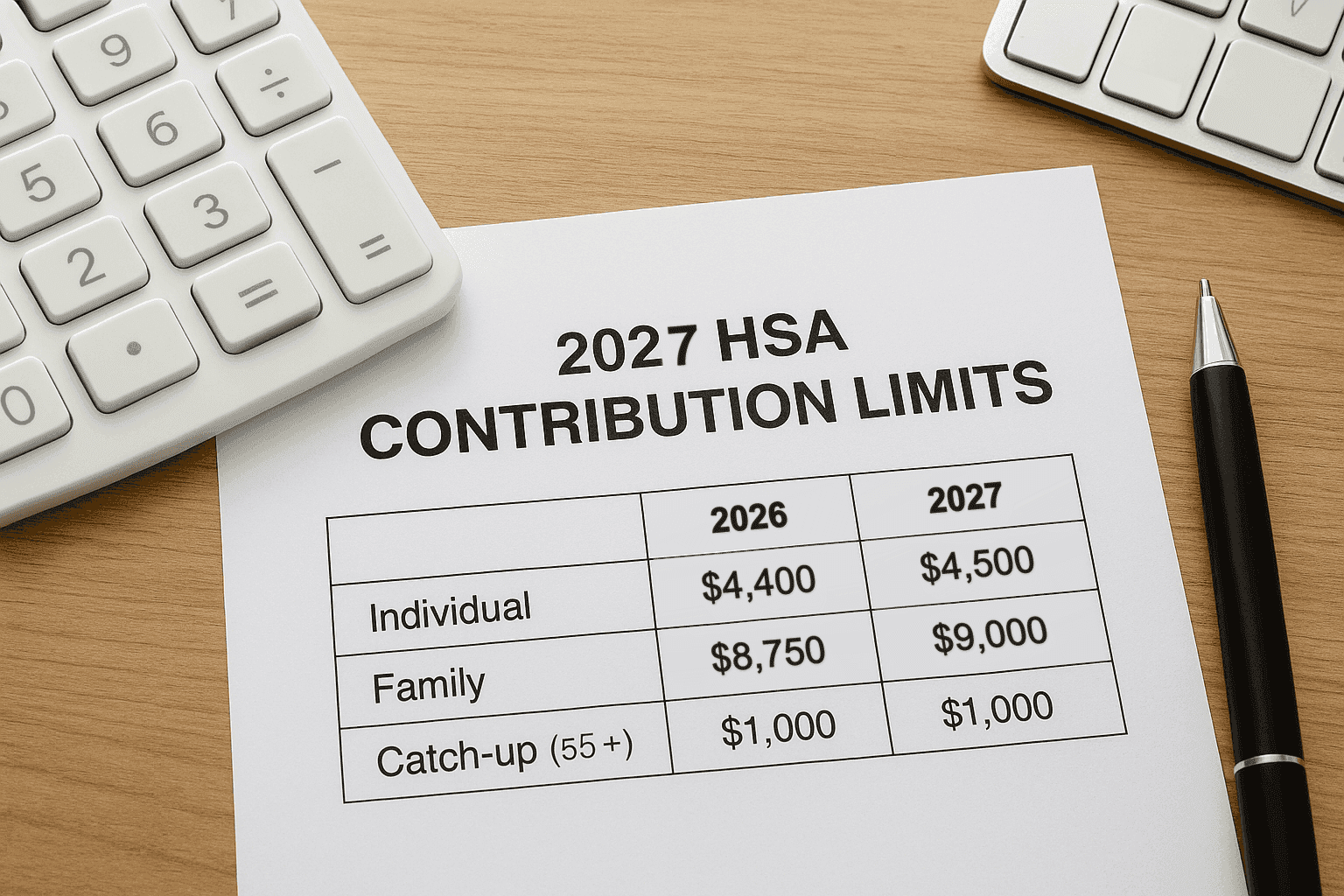
The IRS has set the 2027 HSA contribution limits at $4,500 for self-only coverage and $9,000 for family coverage, up from $4,400 and $8,750 in 2026. The figures come from Revenue Procedure 2026-24 and apply to calendar year 2027.
The $1,000 catch-up contribution for people 55 and older stays the same. The minimum deductibles and out-of-pocket maximums for high-deductible health plans (HDHPs) also went up, which is useful to know if you’re comparing plans during open enrollment.
New to these accounts? Start with What Is an HSA?
2027 HSA Contribution Limits
Here’s how the 2027 HSA limits compare to 2026:
| Coverage Type | 2026 Limit | 2027 Limit | Change |
|---|---|---|---|
| Self-only coverage | $4,400 | $4,500 | +$100 |
| Family coverage | $8,750 | $9,000 | +$250 |
| Catch-up (55 & over) | $1,000 | $1,000 | No change |
Key Details:
The IRS rules below come from Publication 969, whose current edition covers the 2025 tax year.
- Catch-up contribution: The $1,000 amount is written into the tax code and isn’t adjusted for inflation, so it doesn’t appear in the annual revenue procedure. If both spouses are 55 or older, each one makes their catch-up contribution to their own HSA.
- Employer contributions: Money your employer puts in, including payroll contributions through a cafeteria plan, counts toward the limit.
- Partial-year eligibility: Your limit can be lower if you aren’t eligible for the full year or your coverage changes during the year.
- Medicare: Your contribution limit is zero starting with the first month you’re enrolled in Medicare.
- Excess contributions: Contributing more than your limit generally means a 6% excise tax on the excess.
- Deadline: Contributions for a tax year can be made into the following year, up to the IRS deadline. For 2025, that date was April 15, 2026.
2027 HDHP Requirements
You generally need to be covered by an HDHP to contribute to an HSA. Our post on whether HSA contributions are tax deductible covers the other eligibility rules.
For 2027, a plan needs a deductible of at least the minimum below, and out-of-pocket expenses can’t exceed the maximum. Out-of-pocket expenses include deductibles, co-payments, and other amounts, but not premiums.
| HDHP Requirement | 2026 | 2027 | Change |
|---|---|---|---|
| Minimum deductible, self-only | $1,700 | $1,750 | +$50 |
| Minimum deductible, family | $3,400 | $3,500 | +$100 |
| Out-of-pocket maximum, self-only | $8,500 | $8,700 | +$200 |
| Out-of-pocket maximum, family | $17,000 | $17,400 | +$400 |
Two other rules are worth checking if you’re choosing coverage:
- Bronze and catastrophic plans: Since January 2026, these plans are treated as HDHPs if they’re available as individual coverage through an Exchange, even if they don’t meet the deductible and out-of-pocket figures above. See IRS Notice 2026-5.
- Direct primary care: For 2027, a direct primary care arrangement isn’t treated as a health plan for HSA eligibility if the fees for all your arrangements total no more than $150 a month, or $300 a month if an arrangement covers more than one person.
Keeping Records
The limits control what goes into an HSA. The IRS also expects records for what comes out: Publication 969 says you need to be able to show that distributions paid for qualified medical expenses, that those expenses weren’t already paid or reimbursed from another source, and that you didn’t take them as an itemized deduction.
That matters most if you follow the HSA shoebox strategy, where you pay medical bills out of pocket and reimburse yourself later, since you may need a receipt years after the expense. Our app, Shoebox, is one way to keep them organized: forward a receipt by email or upload a photo, and it stores your HSA expenses in one place. A folder or spreadsheet can work too, as long as the records are there when you need them.
Final Thoughts
For 2027, the HSA contribution limits are $4,500 for self-only coverage and $9,000 for family coverage, plus the unchanged $1,000 catch-up for people 55 and older. HDHPs need a minimum deductible of $1,750 or $3,500, with out-of-pocket maximums of $8,700 or $17,400.
The 2026 limits still apply to your 2026 contributions, and the 2027 limits apply to contributions for 2027.
Sources
- Rev. Proc. 2026-24: 2027 inflation-adjusted amounts for HSAs
- Rev. Proc. 2025-19: 2026 inflation-adjusted amounts for HSAs
- IRS Notice 2026-5: Expanded Availability of Health Savings Accounts
- IRS Publication 969: Health Savings Accounts and Other Tax-Favored Health Plans
- 26 U.S. Code § 223: Health savings accounts
This article is for informational purposes only and does not constitute tax or legal advice. Consult a licensed tax professional for advice specific to your situation.