
Quick Answer
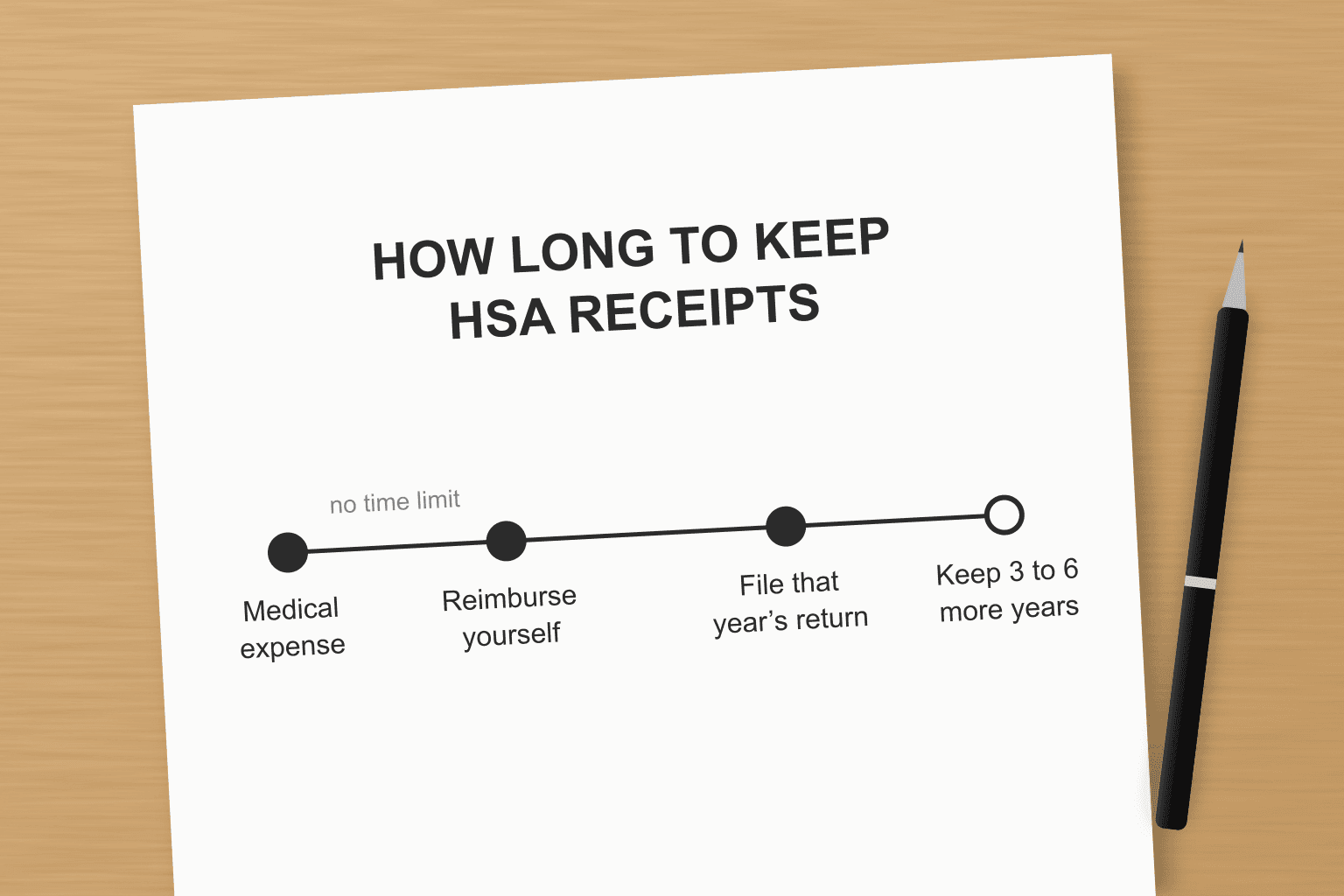
Keep each HSA receipt until you’ve reimbursed yourself for that expense, then for at least three more years after you file the tax return that reports the reimbursement. Six years is a cautious target, especially for a large reimbursement. If you haven’t reimbursed yourself yet, keep the receipt, because the clock hasn’t started.
The IRS doesn’t publish a retention period written specifically for HSA receipts. Publication 969 says what your records must show and tells you to keep them with your tax records, but it gives no number of years. The timeline below comes from applying the IRS’s general recordkeeping rules to HSAs. That’s our reading, not an IRS statement about HSAs, so talk to a tax professional if a large amount is at stake.
What the IRS Actually Says
Three IRS sources fit together:
- What to keep: Publication 969 says you “must keep records sufficient to show” that distributions paid only for qualified medical expenses, that those expenses weren’t already paid or reimbursed from another source, and that you didn’t take them as an itemized deduction in any year. Our guide to the records the IRS expects covers this in detail.
- No deadline to reimburse: Notice 2004-50, Q&A 39, says “there is no time limit on when the distribution must occur,” as long as the expense came after the HSA was established. The same answer says you must keep records “sufficient to later show” that the distribution qualified. This is what makes the HSA shoebox strategy possible.
- How long to keep tax records: IRS Topic 305 says to keep records that support an item on a return for as long as they may become material, “which generally will be until the period of limitations expires for that return.” For most returns, that’s three years from filing.
The question is which return. You report HSA distributions on Form 8889 for the year you take the money out, so we read the clock as running from that year’s return, not from the year of the medical bill.
How Long to Keep a Receipt
| Your situation | Keep the receipt | Why |
|---|---|---|
| You haven’t reimbursed yourself yet | Until you do, with no end date | There’s no time limit on reimbursing yourself |
| You reimbursed yourself | At least 3 years after filing that year’s return | The general IRS period for most returns |
| You took a large reimbursement | 6 years after filing, as a cautious target | See below |
| You paid with your HSA debit card | The same clock, from the return for the year of the purchase | Debit card spending counts as a distribution |
| You didn’t file a return, or filed a fraudulent one | Indefinitely | The IRS’s general rule |
A return filed before its due date is treated as filed on the due date.
An Example
You pay a $1,200 dental bill out of pocket in 2026 and reimburse yourself in 2046. You report the distribution on your 2046 return, filed in April 2047. The three-year window runs to about April 2050, so that receipt needs to stay readable for roughly 24 years. A six-year target would take it to about April 2053.
Why Six Years Is a Cautious Target
The IRS’s six-year period applies when you leave out income that’s more than 25% of the gross income shown on your return. Suppose you reimburse yourself $40,000 in one year on a return showing $100,000 of gross income, and the IRS later decides the distribution didn’t qualify. That’s when the longer window could matter.
The IRS doesn’t say how this applies to HSA reimbursements. Federal law leaves amounts adequately disclosed on the return out of the 25% test, and Form 8889 does report the distribution, so the three-year window may well be the one that applies. We haven’t found guidance that settles it, and keeping a receipt for three more years costs very little.
What About Seven Years?
You may see seven years quoted. The IRS’s seven-year period is for claims involving a loss from worthless securities or a bad debt deduction, so it isn’t an HSA rule. Keeping a receipt that long does no harm, but nothing in the HSA guidance requires it.
Records to Keep Even Longer
A receipt isn’t the only record that matters. These tend to outlast it:
- Your HSA’s start date: Expenses incurred before you establish your HSA don’t qualify, and state law decides when that happened. Notice 2008-59, Q&A 38, says most state trust laws require an HSA to be funded to be established, so keep the first statement showing money in the account. If you moved your HSA to a new provider, a transferred account keeps the earlier date (Q&A 40).
- Filed tax returns: The IRS says to keep copies of them. You may need your returns to show you never deducted an expense on Schedule A, and that rule covers “any year.”
- Forms 1099-SA and 8889: These show what you withdrew and how you reported it. Keep them with the return for that year.
If You Die With Unreimbursed Receipts
What happens to those receipts depends on who inherits the account, so make sure someone knows where they are.
- Your spouse is the beneficiary: Publication 969 says the HSA is treated as your spouse’s HSA. It doesn’t directly say whether your spouse can use receipts for bills you paid earlier.
- Anyone else is the beneficiary: The account stops being an HSA, and its value becomes taxable to the beneficiary in the year you die, or goes on your final return if your estate is the beneficiary. A beneficiary other than your estate can reduce that amount by your qualified medical expenses that they pay within one year of your death. That wording covers bills the beneficiary pays. It doesn’t appear to cover old bills you already paid, though the IRS doesn’t address this directly.
If you’re holding a large unreimbursed balance, this is worth raising with a tax or estate professional.
Make Sure the Receipt Survives
A receipt you can’t read 20 years from now won’t help you.
- Scan early: Store and pharmacy receipts are often printed on thermal paper, which can fade. Check that the image is readable before you rely on it.
- Know the limits of scans: Publication 17 says the IRS doesn’t require you to keep records in a particular way. Revenue Procedure 97-22 lets taxpayers using an electronic storage system destroy paper originals if the system meets requirements such as legible reproduction and indexing. It reads as if it was written for business record systems and doesn’t mention HSAs, so the IRS hasn’t answered the phone photo question directly. Digital copies are a sensible way to keep receipts. For a big bill, also keeping the paper or the provider’s PDF is cheap insurance.
- Keep a copy you control: Phones, apps, and HSA providers can all change over 20 years. Whatever you use, download your records about once a year and save a backup.
- Replace what’s missing now: If a receipt is lost or fading, ask the provider, pharmacy, or insurer for a copy while it’s easy to get.
Final Thoughts
There’s no IRS rule that says “keep HSA receipts for X years.” The practical answer is to keep each receipt until you’ve reimbursed yourself, then at least three more years after filing that return, and six if you want extra room. If you plan to reimburse yourself decades from now, that means decades of storage.
A folder and a spreadsheet can handle that. Apps can make it easier, and our comparison of HSA receipt apps covers how the options differ, including free ones.
Sources
- IRS Publication 969: Health Savings Accounts and Other Tax-Favored Health Plans (2025 edition)
- Instructions for Form 8889 (2025 edition)
- IRS Notice 2004-50: Health Savings Accounts, Additional Q&As
- IRS Notice 2008-59: Health Savings Accounts Q&As
- IRS Topic 305: Recordkeeping
- IRS: How long should I keep records?
- IRS Publication 17: Your Federal Income Tax
- Revenue Procedure 97-22, in Internal Revenue Bulletin 1997-13
- 26 U.S. Code § 6501: Limitations on assessment and collection
This article is for informational purposes only and does not constitute tax or legal advice. Consult a licensed tax professional for advice specific to your situation.
Shoebox stores your HSA receipts in one place: forward them by email or upload a photo, and download them whenever you need them. It costs $60 a year, with a 30-day trial and no card required. Start your free trial