
Quick Answer
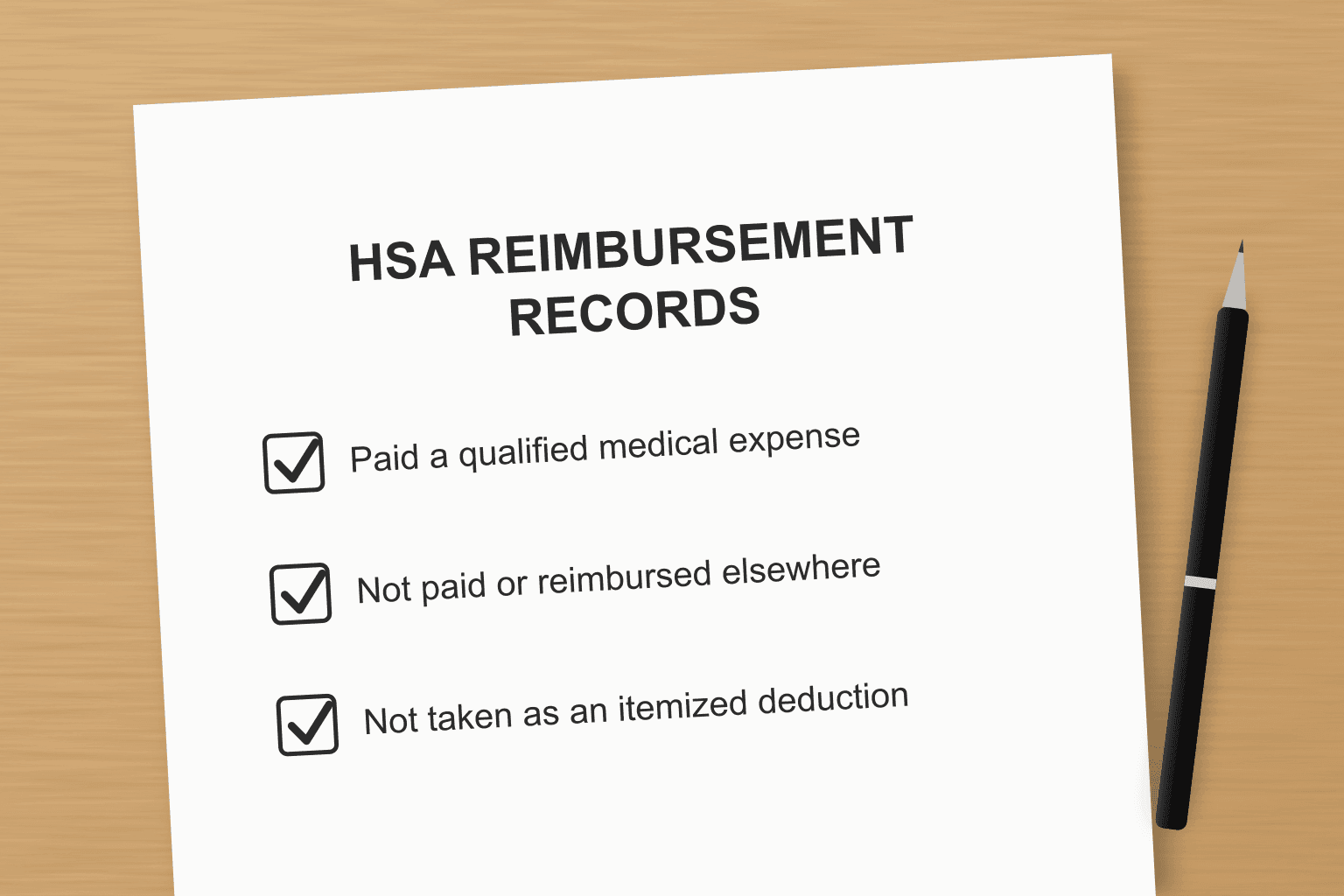
The IRS doesn’t give you a list of required documents. Instead, Publication 969 says you “must keep records sufficient to show” three things about your HSA distributions:
- They were used only to pay or reimburse qualified medical expenses.
- Those expenses hadn’t already been paid or reimbursed from another source.
- Those expenses hadn’t been taken as an itemized deduction in any year.
You don’t send these records with your tax return, and your HSA provider generally won’t check them. They’re for you to produce if the IRS asks. The document suggestions below are our practical reading of the rules, since the IRS doesn’t spell them out.
Documents That Can Show Each Thing
| What your records must show | What can show it |
|---|---|
| The money paid for a qualified medical expense | An itemized receipt or provider bill showing who got the care, from whom, when, for what, and how much |
| No one else already paid or reimbursed it | An Explanation of Benefits (EOB) from your insurer showing what you owed, plus any FSA or HRA claim history |
| You didn’t deduct it | Your filed returns, including Schedule A for any year you itemized medical expenses |
Two details are easy to miss:
- Debit card purchases need records too: Publication 969 says your distributions include amounts paid with a debit card. These rules aren’t only for people who reimburse themselves later.
- Spouses can’t double up: If you both have HSAs, either one can pay the other’s qualified expenses, but Notice 2004-50, Q&A 38, says “both HSAs may not reimburse the same expense amounts.”
You Also Need Two Dates
Timing isn’t on the Publication 969 recordkeeping list, but an expense incurred before you established your HSA isn’t a qualified medical expense. So you need to be able to show both dates:
- When your HSA was established: State law decides this. Notice 2008-59, Q&A 38, says most state trust laws require an HSA to be funded to be established, so your first statement showing a deposit is useful. If your money was transferred from an earlier HSA, the new account keeps the earlier date (Q&A 40).
- When the expense was incurred: Publication 969 doesn’t define “incurred” for HSAs. The date you received the care is the cautious date to use, rather than the date you were billed or paid. Make sure the date of service appears on your record.
What a Good Receipt Shows
The IRS doesn’t list required fields for an HSA receipt. Two reference points can help:
- The health FSA rule: For FSAs, Publication 969 requires “a written statement from an independent third party” stating that the expense was incurred and its amount. This rule doesn’t apply to HSAs, but it’s a useful standard to aim for.
- HSA provider guidance: Optum Financial, when it asks cardholders to verify a purchase, wants a receipt showing the date, the exact amount, the provider or merchant, the person who received the care, and a detailed description.
That gives you a practical checklist:
- Patient name
- Provider or merchant name
- Date of service or purchase
- Description of the service or item
- Amount you paid
Situations That Need More
- A card statement on its own: It shows you paid a merchant, but not what you bought. The IRS doesn’t address card statements for HSAs specifically, so treat one as a backup to an itemized receipt.
- A store receipt with mixed items: Only the eligible items count. Make sure the item names are readable and note the eligible amount.
- A bill that insurance is still processing: Wait for the EOB and use what you actually owed, not the amount the provider first billed.
- Items that only qualify for a medical reason: Publication 502 says a weight-loss program counts only as treatment for a specific disease diagnosed by a physician, and supplements count only when a medical practitioner recommends them as treatment for a specific diagnosed condition. Keep the practitioner’s note with the receipt.
- Over-the-counter medicines: The Form 8889 instructions say nonprescription medicines qualify for HSA purposes, so no prescription is needed. You still want the receipt.
- Insurance premiums: These generally don’t qualify. The exceptions are long-term care insurance, COBRA-type continuation coverage, coverage while receiving unemployment compensation, and Medicare and other coverage if you’re 65 or older (but not Medigap).
- Care for someone else: Expenses can qualify for you, your spouse, and your tax dependents, with limited exceptions. The test is tax status, not whether the person is on your health plan, so the patient’s name matters.
Records of the Reimbursement Itself
Your provider reports distributions on Form 1099-SA, but that form doesn’t connect a withdrawal to any particular expense. You do that on Form 8889, which you must file for any year you took a distribution:
| Form 8889 line | What goes there |
|---|---|
| Line 14a | Total distributions, from box 1 of Form 1099-SA |
| Line 15 | The part used for qualified medical expenses not reimbursed by insurance or other coverage and incurred after the HSA was established |
| Line 16 | The part included in your income |
| Line 17b | The additional 20% tax, if it applies |
The IRS doesn’t require a particular format for connecting withdrawals to expenses, but a simple log makes it much easier. One withdrawal can cover several old receipts, and a log also stops you from claiming the same receipt twice. For each expense, record the date of service, patient, provider, amount, how much you’ve reimbursed, and when.
Who Checks Your Records?
Not your HSA provider. Notice 2004-2, Q&A 29, says trustees and custodians aren’t required to determine whether distributions are used for qualified medical expenses. The IRS model custodial agreement, Form 5305-C, says only the account owner is responsible for substantiating them. So a withdrawal going through doesn’t mean it qualifies.
If you can’t show a distribution paid for a qualified expense, it’s included in your income and generally subject to an additional 20% tax. That extra tax doesn’t apply to distributions made after you become disabled, reach age 65, or die. For example, a $2,000 distribution that doesn’t qualify would cost $840 for someone under 65 in the 22% bracket: $440 of income tax plus the $400 additional tax.
If You Reimbursed Yourself by Mistake
There’s a fix, but it’s narrow. The Form 8889 instructions say it applies only in “very limited and unusual circumstances.” Under Notice 2004-50, Q&A 37, you need clear and convincing evidence of a mistake of fact due to reasonable cause, and you must repay by April 15 following the first year you knew or should have known about the mistake. Your provider doesn’t have to accept the repayment (Q&A 76), so ask them first.
Where the IRS Isn’t Clear
Here’s what the guidance leaves open:
- Exact documents: There’s no official checklist for an HSA reimbursement. The standard is what’s “sufficient to show” the three facts above.
- How long to keep records: Publication 969 gives no number of years. Our guide on how long to keep HSA receipts works through the general rules.
- Photos and scans: Publication 17 says the IRS doesn’t require a particular way of keeping records, and Revenue Procedure 97-22 covers electronic storage systems, but neither addresses HSA receipts directly.
- What “incurred” means for an HSA: Publication 969 doesn’t define it, which matters most for care around the date you opened your account.
If a large reimbursement depends on one of these points, ask a tax professional before you rely on it.
Final Thoughts
For each reimbursement, you want to be able to show what the expense was, who it was for, when it happened, that no one else paid it, and that you didn’t deduct it. An itemized receipt, an EOB, your tax returns, and a simple log cover most of that.
If you’re planning to reimburse yourself years from now, our HSA shoebox strategy post explains how that works, and our comparison of HSA receipt apps covers ways to store everything, including free ones.
Sources
- IRS Publication 969: Health Savings Accounts and Other Tax-Favored Health Plans (2025 edition)
- Instructions for Form 8889 (2025 edition)
- IRS Publication 502: Medical and Dental Expenses (2025 edition)
- IRS Notice 2004-2: Health Savings Accounts
- IRS Notice 2004-50: Health Savings Accounts, Additional Q&As
- IRS Notice 2008-59: Health Savings Accounts Q&As
- IRS Form 5305-C: Health Savings Custodial Account
- IRS Publication 17: Your Federal Income Tax
- Revenue Procedure 97-22, in Internal Revenue Bulletin 1997-13
- Optum Financial: How to upload an itemized receipt
This article is for informational purposes only and does not constitute tax or legal advice. Consult a licensed tax professional for advice specific to your situation.
Shoebox keeps your HSA receipts and reimbursements in one place, and its Tax Center lets you download each year’s reimbursements as a CSV along with their receipts. It costs $60 a year, with a 30-day trial and no card required. Start your free trial